Fiber access networks are expanding as operators support cloud services, remote work, and higher household bandwidth demand. The OECD Broadband Portal continues to show strong fiber growth across advanced broadband markets. The FTTH Council Europe Market Panorama also reports sustained expansion in fiber-to-the-home coverage and subscriptions. These figures point to a practical issue: reliable distribution hardware matters as much as the cable itself.
A 12 Port Fiber Termination Box gives installers a compact point for splicing, protecting, and organizing up to twelve fiber connections. Inside, trays should hold splice sleeves securely, while adapters must maintain accurate alignment and low signal loss. A technician working in a narrow cabinet also needs clear labeling, bend-radius control, and tool-free access. Small details become expensive during maintenance.
This guide examines 12 leading 12-port fiber termination boxes for FTTH deployments. It considers enclosure strength, ingress protection, splice capacity, adapter compatibility, installation speed, and long-term serviceability. Relevant practices include IEC connector standards and ITU-T access-network recommendations. Product specifications were compared with real installation needs, not marketing claims alone.
No ranking fits every network.
A weatherproof outdoor box may be excessive indoors. A low-cost model may also create hidden labor costs through poor tray design or weak hinges. Reported performance can vary with connector quality, installer technique, and environmental conditions. That limitation deserves attention. The best choice is not always the most advanced box, but the one that protects fibers, reduces troubleshooting time, and matches the site’s actual demands.
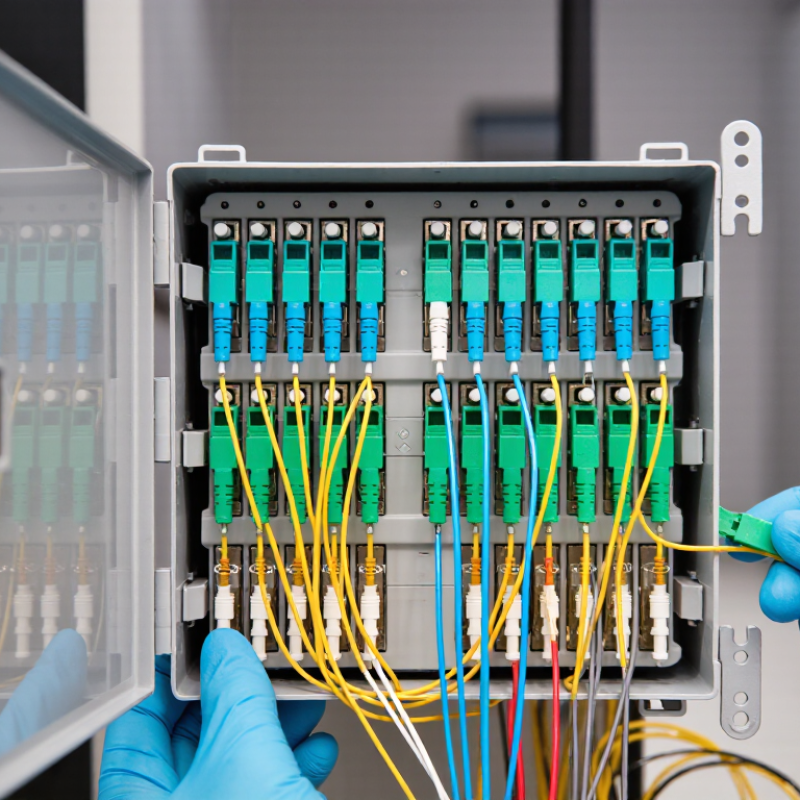
In an FTTH network, a 12-port fiber termination box is a compact enclosure that organizes and protects up to twelve fiber terminations. It usually sits where the feeder cable meets distribution or drop cables. Inside, adapters, splice holders, pigtails, and slack-storage guides keep optical paths controlled. The box does not amplify signals. It provides a clean, serviceable connection point.
Each port normally connects one fiber through an adapter, although capacity depends on the internal layout. Technicians route incoming fibers into a splice tray, protect fusion splices, and connect pigtails to the adapter panel. A proper box maintains the cable’s minimum bend radius. It also limits dust, accidental pulling, and moisture when its seal is correctly installed. Labels matter. A clear port map can reduce testing time and prevent costly reconnections.
Selection should match the installation, not only the port count. Check fiber type, connector format, mounting method, cable entry size, sealing level, and working space. In crowded cabinets, twelve ports may sound sufficient but leave little room for future subscribers. That assumption deserves review. Field work also shows that weak slack management creates sharper bends after maintenance. A durable enclosure helps, but careful routing remains essential. Before acceptance, inspect splice protection, connector cleanliness, bend radius, and continuity with calibrated test equipment.
| Profile | Recommended Network Role | Fiber Port Capacity | Adapter Configuration | Splice Capacity | Supported Cable Diameter | Enclosure Material | Ingress Protection | Typical Dimensions (H × W × D) | Mounting Method | Operating Temperature | Key Strength |
|---|---|---|---|---|---|---|---|---|---|---|---|
| Profile 1 | Indoor apartment distribution | 12 fiber ports | 12 SC simplex or 12 LC duplex adapter positions | 12 fibers | 2–8 mm drop or feeder cable | ABS and polycarbonate | IP54 | 210 × 145 × forty-five mm | Wall or pole mounting | −25°C to +55°C | Compact layout for building risers and indoor cabinets |
| Profile 2 | Outdoor residential access point | 12 fiber ports | 12 SC simplex adapter positions | 24 fibers | 4–12 mm cable | UV-resistant ABS and PC | IP65 | 250 × 190 × seventy-five mm | Wall, pole, or aerial mounting | −40°C to +60°C | Weather-resistant housing with separate splice and termination areas |
| Profile 3 | High-density FTTH floor distribution | 12 fiber ports | 6 LC duplex adapter positions | 24 fibers | 3–10 mm cable | Polycarbonate | IP55 | 220 × 160 × sixty mm | Wall mounting | −25°C to +60°C | Uses LC duplex adapters to save front-panel space |
| Profile 4 | Small business fiber demarcation | 12 fiber ports | 12 SC duplex adapter positions | 24 fibers | 5–14 mm cable | Flame-retardant ABS | IP55 | 280 × 210 × eighty-five mm | Wall mounting | −20°C to +55°C | Provides room for patching, splicing, and fiber identification |
| Profile 5 | Outdoor pole-mounted FTTH node | 12 fiber ports | 12 SC simplex adapter positions | 24 fibers | 6–16 mm cable | UV-stabilized polycarbonate | IP66 | 300 × 220 × 100 mm | Pole or wall mounting | −40°C to +70°C | Sealed construction for dust, rain, and outdoor temperature changes |
| Profile 6 | FTTH drop-cable termination | 12 fiber ports | 12 SC simplex adapter positions | 12 fibers | 1.5–5 mm drop cable | ABS | IP54 | 190 × 125 × forty-five mm | Indoor wall mounting | −20°C to +55°C | Designed for small bend-radius drop cables and quick installation |
| Profile 7 | Central-office or cabinet sub-distribution | 12 fiber ports | 12 LC duplex adapter positions | 24 fibers | 4–12 mm cable | Powder-coated steel | IP30 | 220 × 145 × sixty-five mm | Rack side, cabinet, or wall mounting | −10°C to +60°C | Rigid enclosure suited to protected indoor telecom spaces |
| Profile 8 | Industrial or utility FTTH connection point | 12 fiber ports | 12 SC simplex adapter positions | 24 fibers | 5–16 mm cable | Polycarbonate with stainless-steel hardware | IP66 | 310 × 235 × 105 mm | Wall or pole mounting | −40°C to +70°C | Strong sealing and corrosion-resistant hardware for demanding locations |
| Profile 9 | Low-profile indoor subscriber terminal | 12 fiber ports | 12 LC simplex adapter positions | 12 fibers | 2–7 mm cable | ABS and PC | IP40 | 180 × 120 × forty mm | Wall or cabinet mounting | −10°C to +50°C | Shallow design for corridors, apartments, and compact communication rooms |
| Profile 10 | Pre-connectorized FTTH deployment | 12 fiber ports | 12 SC simplex adapter positions | 12 fibers | 3–10 mm cable | Polycarbonate | IP65 | 240 × 175 × seventy mm | Wall or pole mounting | −30°C to +60°C | Supports organized adapter fields and factory-terminated assemblies |
| Profile 11 | High-fiber-count feeder transition | 12 fiber ports | 12 SC simplex adapter positions | 36 fibers | 8–18 mm cable | Reinforced polycarbonate | IP66 | 340 × 250 × 120 mm | Wall, pole, or aerial mounting | −40°C to +70°C | Extra internal volume for feeder slack, splice trays, and cable management |
| Profile 12 | Harsh-environment outdoor access network | 12 fiber ports | 12 ruggedized SC simplex adapter positions | 24 fibers | 6–18 mm cable | Glass-fiber-reinforced polyester | IP67 | 320 × 240 × 115 mm | Wall or pole mounting | −40°C to +75°C | Highest environmental protection for exposed fiber access points |